A Guide to Becoming A Psychologist
This guide is for anyone considering to become a psychologist. We can talk about getting your clinical license after you get through undergraduate, which is honestly the worst part.
You probably don’t want to be a psychologist. When people ask you why want to be a psychologist, you’ll probably say it’s because you want to understand people, to help people, where people in this case usually means you.
Your desire to understand yourself is innately pathological. Your desire to heal others is an avoidance of your own wounds. Your conceptions of what psychological health are drastically wrong, as are your interpretations of anything said by any figure in the history of psychiatry, including anything anyone who claims to really know what those figures really mean.
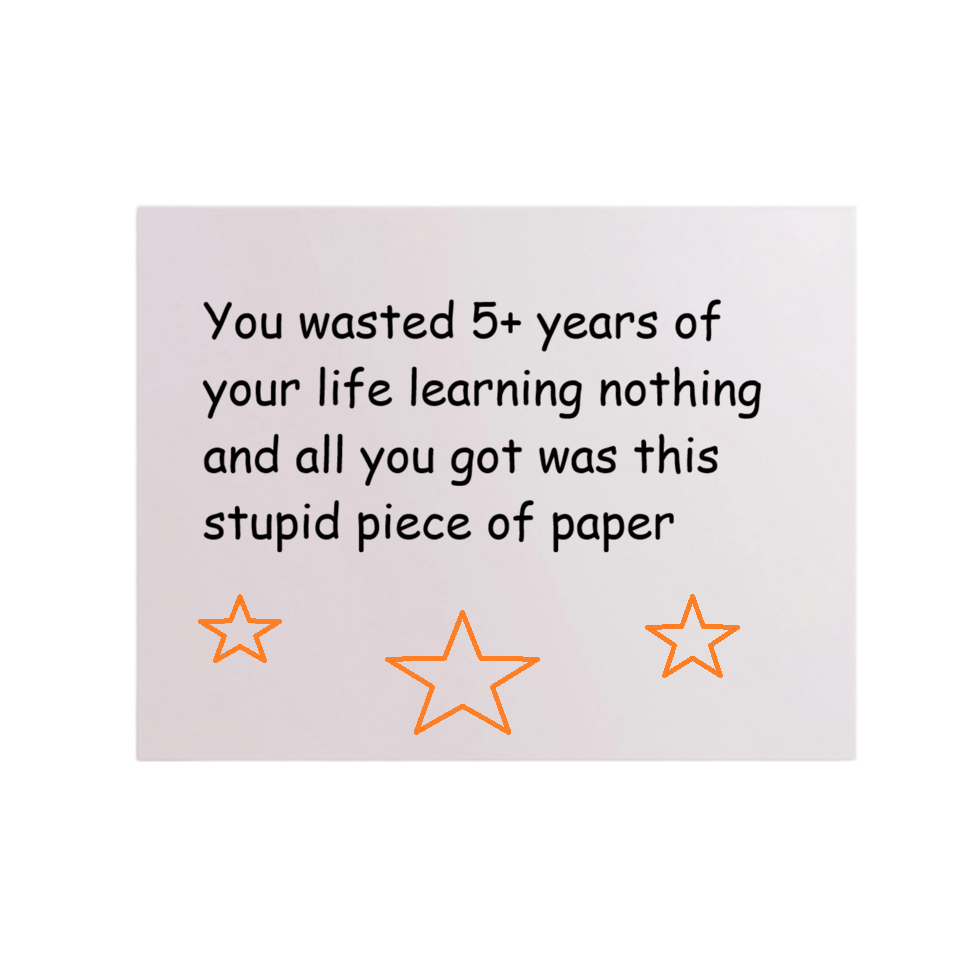
The undergraduate degree is a great filter. When people ask what it’s like, I tell them it’s like high school. You’ll spend 3-4 years learning 4 completely different, mostly unrelated subjects a semester and then be handed a sheet of paper. You will learn nothing of what is means to be a psychologist, no novelties, certainly nothing that brings you closer to understanding what being a psychologist and treating people is like.
You will see a lot of bullshit, namely social science, pop-psychology, and a lot of statistics.
The first is tedium, the second you can get from a podcast, and the third is more tedium, but the kind that they will hold your hand for.
The 2 major requirements for getting through undergrad is a little conscientiousness, and a pulse. There goes about 70% of the population, reflected by the psych major dropout rates. Plenty of people go into psychology, and go, correctly “This is bullshit”, and change course. They become teachers, or nurses, or go into another actual science, because they realised that they actually don’t want to be a psychologist, no one sane wants to be a psychologist, it’s one of the great paradoxes of being a psychologist. You must simultaneously empathise with the insanity and separate yourself from it, otherwise you or your first patient will find themselves with an extra disorder than when they started.
The only year that matters is the last year of your undergraduate, where your grades decide if you can get into post-graduate. That doesn’t mean you can slack off, learning to be a good student is an actual task, and you can’t spend 2-3 years opening doors only to lock in at the last moment. Habit doesn’t work like that, and working hard is a habit.
Universities have changed a lot. In the short time I went from visiting the university I wanted to study at, to actually going there, it became a shadow of itself. Academia is in a crisis. If you’re lucky you may have 1 good professor a year, maybe a single good tutor. They are all overworked and underpaid for a job to teach you what they know to be nonsense, because they had to have a degree in it to teach the material. Try to form a relationship with them anyway, because supervisors care about enthusiasm, and having a good relationship with either cannot hurt your grades.
Now, you’re going to need to be good at exams, because everyone cheated too much and the trust has been broken, and degrees are basically worthless via inflation because Universities make it nearly impossible to fail and are incredibly corrupt in every sense. Again, academia is in crisis, and that’s not your fault. It doesn’t mean you shouldn’t care about the material. It just means that if you want to be a psychologist, you shouldn’t think the material is going to make you a psychologist. You will learn more about psychology and the human condition in half a dozen nights of people watching than you will in your undergrad. Study it anyway, because it’s on the test, and learning is a skill.
You’re again going to really need to ask yourself why you are doing this. What do you actually want to do, because what you think psychologists do is probably very wrong, or you have experienced it from the wrong side of the couch.
You’re probably going to need therapy to figure out why you want to be a psychologist, and to make sure that whatever baggage you do have doesn’t get passed on to your patients.
Is it because you enjoy pop-psychology? Do you like feeling like you understand people? Take note, people, plural. You can understand people, but it takes far more work to understand a person, which is a requirement of actually treating someone.
Is it because you want to know someone, intimately, everything about them? Firstly, therapy, for you, secondly, try love, but not with your therapist, though with this drive erotic transference is extremely likely. Find a therapist the same sex as you, it’ll help.
Therapy is not for finding friends, or falling in love, or feeling connected. You might want to be those things with your patients, the feeling might even be mutual, but to do so is a fundamental violation of ethics. I don’t mean ethics, I mean if you violate this rule you should never have been approved to practise in the first place. The idea of a wounded healer is very popular, and anyone who has been wounded badly enough to want to become a psychologist can never truly be fully healed, only scarred, but a scarred healer is better than a wounded healer. Do the work. Make sure your life is actually on track to being healthy before trying to help others do the same. Suffer first for your loved ones, your family, your friends. If you are suffering for strangers, you should check that you are not doing so because you lack meaningful connections.
Your job as a psychologist is to help people change.
Most psychologists are glorified self-help books, and despite the amount of popular on the topic of “self-help” coming out each year, people fail to change. There are some great self-help books out there. Yet, the failure rate is almost 100%. The reader gains some insights, the author (therapist) feels good, like they did something, and money changes hands, but that’s the only thing that changed. The insights sit there on the bookshelf – proof that you bought it, read it, maybe even thought about it. But, it’s gathering dust, unmoving.
You cannot force someone to change, no more than the book jump off the shelf and force itself into their brain. People don’t want to change, because change is very painful, expensive, and takes a very long time. People will do almost anything to not change – including therapy. Proof that you are trying, that you are buying into the possibility of change, is not the same as changing, and therapists fail to differentiate between the two, often because that might mean acknowledging that you’re both wasting each other’s time. They get to pretend they’re changing, you get to pretend you’ve made them, you both get to pretend you’ve done the work.
So if you can’t force the patient to change, or they might not actually want to change, what can you do?
Nothing.
If the patient is ambivalent, you can see if you can help them see how change might be not only good for them, but for the people around them. Patients regularly drop hints, consciously or not, about what they really want.
That requires you to really listen to the patient, not just to their words, but their body language, the tone, all of it, and not flinch or react when you hear secondhand some of the worst and most terrible things imaginable. Sometimes for years.
You will fail at this. It is inevitable.
You will watch people for years circling the same ideas waiting for a single true sentence to come out of their mouth, so that you can engage with it based on everything you’ve learned before.
You will be doing this for 20+~ people a week. Depends on how bad your student debt and mortgage is.
All while caring for your family, your loved ones, your friends, and living a normal healthy life, and hopefully listening to them just as carefully.
Now, really consider: why are you doing this?
There’s better ways to make money. More reputable ways. I think Psychology’s current reputation is worse than what we think of the “Golden Age” of Psychoanalysis now. You are at best, someone who can help people, and worst, a pseudointellectual guru who spouts platitudes and conventional knowledge that people can get from a bookstore for $30. If you had any real gusto you would’ve become a psychiatrist, where you can address the pharmaceutical and biological basis of pathology. But that’s 10~ years of your life, again, too much for any sane person. At least then you get to put a bunch of titles that people recognise in your name. But that’s too much for you, isn’t it? Too much commitment, too much hard work for too long, for just a chance to do the full work.
And maybe that’s why you want to be a psychologist, or worse, a clinician, because maybe then you will feel like diagnosing is the same as treating, or puts you on the same path.
It doesn’t.
Do literally anything else.
Please. I beg you.